

La Defense

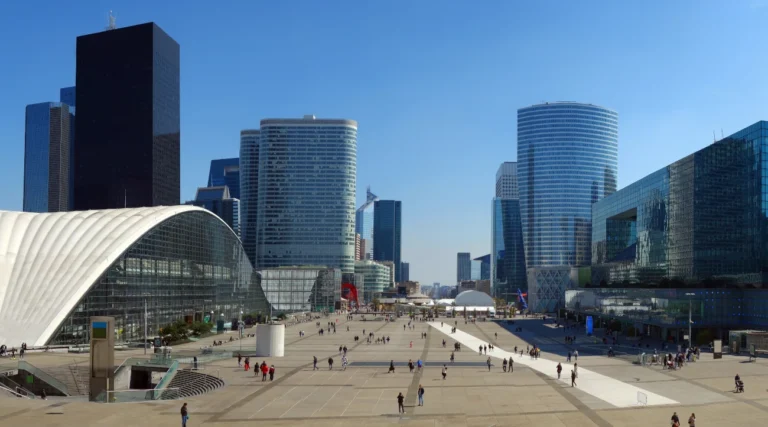
Beyond the city's historic borders lies a forest of glass and steel, a monumental urban planning laboratory where financial giants coexist with open-air art installations.

In short

Table of Contents

What to know before visiting La Défense

The upper section of the complex is entirely pedestrian, built on a gigantic concrete esplanade known as the "Dalle." Directional signs are easy to navigate, but the vastness of the space requires good walking shoes to move from one tower to the next.

The strong points

  • Unique photographic perspectives in the world.
  • Pedestrian spaces free of cars.
  • Incredible concentration of public art.
  • Huge shopping centers always open.

To keep in mind

  • Strong winds among the skyscrapers.
  • Very cold atmosphere this weekend.
  • The internal restaurants are very crowded at lunchtime.
  • Little neighborhood life at night.

What to see in the La Défense district

The itinerary unfolds along the central axis of the large esplanade, moving between bold engineering solutions and hanging gardens.

1

Great Arche de la Défense Splendid

The titanic hollowed-out cube covered in white marble and glass, designed to house the Ministry of Transport.

2

César's Thumb

A monumental twelve-meter-high bronze sculpture that faithfully reproduces the fingerprint of artist César Baldaccini.

3

The Two Plateaus of Buren

The geometric installation by artist Daniel Buren, characterized by vertical elements that punctuate the space of the lower square.

4

Agam Monumental Fountain

A kinetic work of art consisting of a large mosaic pool that offers water games and music shows.

5

Tour First

The tallest skyscraper in the district and in the entire nation, recognizable by its characteristic slender spiral shape.

6

Takis Basin

A body of water decorated with fifty-one mysterious colored metallic signals that seem to float on the liquid surface.

7

Westfield Les 4 Temps Historical Detail

One of the largest shopping centers in Europe, a shopping hub with hundreds of shops and cinemas.

8

CNIT (Centre des Nouvelles Industries)

The pioneering 1958 building is famous for its spectacular reinforced concrete vault with no internal pillars.

Visiting the La Défense district

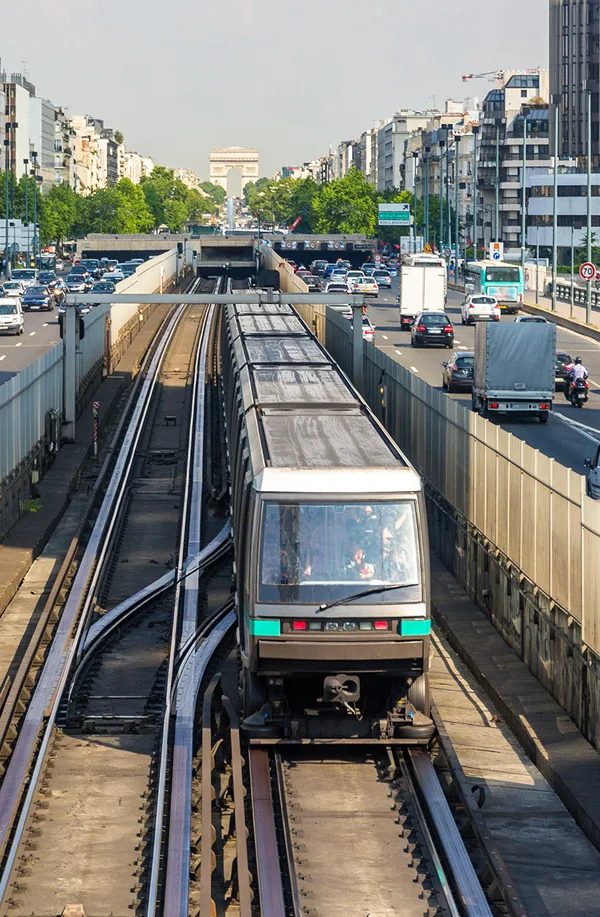
Exploring the district offers a stark visual contrast to the Paris of the 19th-century boulevards, revealing the futuristic vocation of the metro.

Things to do in La Défense

Walk along the stone piers of the esplanade to survey the more than sixty works of contemporary art scattered among the skyscrapers before climbing the steps of the Grande Arche.

Powered by GetYourGuide

Need to know

  • The name of the neighborhood pays homage to the statue “La Défense de Paris”, erected to commemorate the resistance of the soldiers in 1870.
  • The entire district sits atop a complex underground network of highways, rail lines, and parking lots.
  • The straight line that runs through the centre of the esplanade starts from the Louvre and passes under the Arc de Triomphe.
  • The CNIT structure still holds the world record for the largest self-supporting concrete vault.

Practical advice

  • Exit at the “Esplanade” metrostation and walk along the esplanade towards the large arch.
  • Bring a windbreaker even in summer: the air currents between the buildings are constant.
  • Visit the area in December to discover one of the largest Christmas markets in the region.
  • Take advantage of the outdoor tables of the food trucks in the square for a quick and affordable lunch.

How to get to La Défense

Located in the first western peripheral belt, the financial hub is connected to the historic center by a high-frequency transport network.

Metro

Line 1 , Grande Arche terminus, to reach the center of the esplanade; Esplanade stop for the eastern section.

Bus

Over fifteen urban and interurban lines converge within the complex's large underground bus station.

Tram

Line T2 connecting the business district directly with the southern neighborhoods along the Seine.

RER

Line A La Défense station, the fastest transport linking the area to the Opéra in just ten minutes.

Central point: Voie Perronet N

History of the La Défense district

The plan to build a business hub outside Paris's historic boundaries took shape in the late 1950s, driven by President Charles de Gaulle. The goal was twofold and strategic: to decongest the capital's historic center, saturated and unable to accommodate large corporate headquarters, and to provide France with a modern economic showcase capable of competing with the financial markets of London and New York. The choice fell on a hilltop occupied by small factories, shacks, and workers' huts.

The founding of the public management body in 1958 marked the start of the largest construction site in Europe. The planners chose a revolutionary urban planning solution for the time: the complete separation of traffic flows. Thus the monumental “Dalle” was built, a thirty-hectare artificial platform reserved exclusively for pedestrians, beneath which the railways, metro, highways, and gigantic service parking lots for employees were channeled.

The face of the neighborhood has changed through successive generations of skyscrapers, from the sober geometric towers of the 1970s to the ecological and sculptural structures of the twenty-first century. The inauguration of the Grande Arche in 1989, on the occasion of the bicentenary of the French Revolution, magnificently completed the design of the Royal Historic Axis. This project transformed a simple cluster of offices into a global symbol of economic power and contemporary architectural research.

Curiosities about the La Défense district

What to book in La Défense

Where to stay in La Défense

The area, commercial and not very touristy or "livable", is a solution for those who need accommodation for work reasons in this area or for those who want to sleep near the Arc de Triomphe.

Where to eat in the La Défense neighborhood

Oxygen

A contemporary restaurant located inside the shopping centre, appreciated for its fast service and international cuisine.

Westfield Les 4 Temps

The Village

A small corner of traditional dining hidden among the old houses that escaped demolition behind the large buildings.

Rue de la République, Puteaux

Food Truck Plaza

The fleet of food trucks that rotate on the esplanade, offering specialties ranging from burgers to artisanal tacos.

Esplanade de la Défense

Frequently Asked Questions

Is the pedestrian area at La Défense open at night?

Yes, the immense raised square remains always accessible to the public, although after office hours the activity slows down significantly.

The panoramic roof of the monumental arch houses exhibition spaces and observation terraces accessible via panoramic glass elevators.

Yes, almost all of the facility's shops, restaurants, and movie theaters are open seven days a week.

A continuous walk from Esplanade station to the base of the Grande Arche takes about twenty minutes at a steady pace.

metrodistrict line 1 allows you to reach the using a standard t+ urban ticket, without additional fares for the suburbs.

Yes, the entire district is conceived as an interactive museum and the monumental sculptures are integrated into the everyday urban fabric.

Absolutely yes, the area is home to numerous accommodation facilities geared primarily towards business tourism and equipped with excellent technological services.

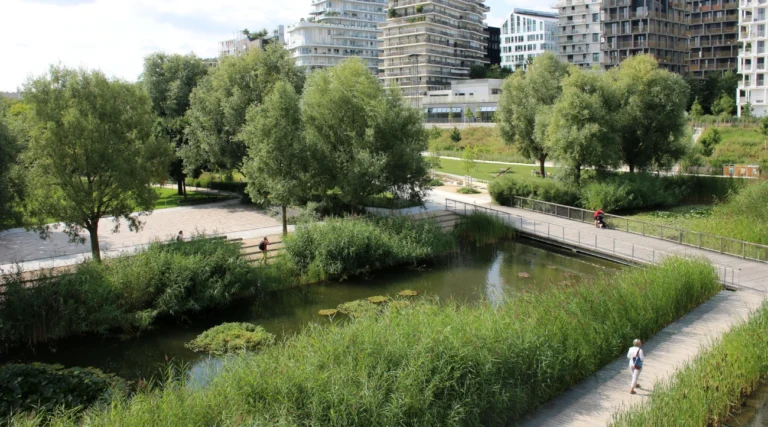
Yes, the edges of the pedestrian platform host the Diderot Park and the hanging gardens suspended above the road ramps.

Other attractions to book in Paris

You might also be interested in...

The journey continues…

Place de la Bastille with traffic around
Historic café in Montmartre
Corner bistro in a Marais building
Grand Palais aerial view
Interior of a Brasserie in Paris
Café in Paris with flowers and fuchsia tables

Activities and tours you can't miss

Share:
Previous
Passy
Next
Montparnasse