

Fountains of the Luxembourg Gardens

A poetic aquatic itinerary through the tree-lined avenues of the most beloved park on the left bank, where monumental baroque pools and historic lakes offer unique oases of peace in Paris.
In short

Table of Contents

The ideal stop

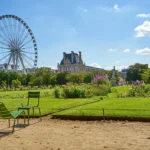
Combine this with a reading break on the famous sage green metal chairs scattered around the octagonal pond.

  • Recommended parking time 40'

    Forty minutes is ideal to complete the tour of the park's main fountains.

  • The local rite

    Rent a small, colorful wooden sailboat to float on the central basin by pushing it with a stick.

What to see at the Luxembourg Gardens Fountains

Stroll through the different sectors of the park to discover the water monuments that decorate the views of the Senate building and the more private paths.

1

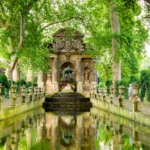
The Medici Fountain The most beautiful

The very long shaded pool of water, culminating in the monumental baroque aedicule with the sculptural group of Polyphemus surprising Acis and Galatea.

2

The Central Grand Bassin

The large octagonal pool located in front of the facade of the building, the beating heart of the park's recreational activities.

3

The Fountain of Leda

The evocative bas-relief hidden at the back of the Medici Fountain, which shows the mythological scene of Leda and the swan sprinkling water into a semicircular basin.

4

The minor sculptural monuments

The side avenues in search of small artistic decorative sources dedicated to poets, hunting deities and queens of France from history.

5

The fountain in the fruit garden

Find the small, discreet stone basin nestled among the rows of historic apple and pear trees cultivated by the Senate gardeners.

Visiting the Fountains of the Luxembourg Gardens

Take your time along the gravel paths, following these quick tips to enjoy the water features while respecting the strict rules of the public park.

How to Visit the Fountains of the Luxembourg Gardens

You can enter through one of the many perimeter gates, such as the one on Boulevard Saint-Michel. Walk towards the palace façade to admire the octagonal Grand Bassin, then enter the grove on the eastern side to discover the Medici Fountain.

Powered by GetYourGuide

Need to know

  • Maria de' Medici wanted to recreate the atmosphere of the Boboli Gardens in her native Florence.
  • The Florentine hydraulic engineer Tommaso Francini designed the structure of the baroque grotto.
  • Originally the Medici fountain was just a decorative facade without the long front pool of water.
  • During Haussmann's 19th-century works, the entire fountain was at risk of being demolished and was moved thirty metres.

Practical advice

  • Check the official website for the exact closing time of the month so you don't get caught by the guards.
  • Bring a book: the shaded area of ​​the Medici Fountain is the coolest place in Paris in summer.
  • Don't dip your feet in the pools: park officials will fine violators severely.
  • If you're traveling with children, bring some coins to rent the historic sailing boats.

How to get to the Fountains of the Luxembourg Gardens

The royal complex is located in the central portion of the sixth arrondissement, bordering the Latin Quarter.

Metro

Line B stops at Luxembourg station, located directly in front of the eastern gates.

Rer

Lines 4 and 10 serve the convenient Odéon stop, five minutes away.

Bus

Lines 21, 27, 38, 82, 84 and 89 stop along the external gates.

Standing

Climb the Sainte-Geneviève hill from Boulevard Saint-Michel.

Rue de Medicis, 75006

History of the Fountains of the Luxembourg Gardens

In 1611, after the assassination of King Henry IV, Queen Regent Marie de' Medici decided to abandon the Louvre Palace and move to a new and grandiose residence that would remind her of her Tuscan origins. She purchased the land of the Duke of Luxembourg and began construction of an immense palace surrounded by formal gardens. Around 1630, the Florentine hydraulic engineer Tommaso Francini created the "Luxembourg Grotto," a monumental decorative stone wall with niches and fake stalactites, fed by the Arcueil aqueduct that brought water to the city.

Over the following centuries, the garden underwent partial abandonment and changes of ownership, but the truly great transformation occurred in the mid-nineteenth century with the drastic urban demolitions orchestrated by Baron Haussmann. The opening of the new Rue de Médicis threatened to erase Francini's work forever; to save it, the Senate architect Alphonse de Gisors decided in 1862 to move the entire monument thirty meters, redesigning the structure. Gisors added the very long rectangular pool flanked by plane trees and commissioned the sculptor Auguste Ottin to create the dramatic bronze and marble sculpture.

At the rear of the same structure, to conceal the newly constructed, bare rear wall, Gisors decided to restore the old Leda Fountain, an eighteenth-century bas-relief salvaged from the demolition of a street intersection in the Saint-Germain district. The two fountains were thus combined into a single monumental block, creating a dual aquatic spectacle that contrasted with the linearity of the large central octagonal body of water built in front of the imperial palace.

Today, the Luxembourg Gardens' water system is a delicate technological masterpiece, constantly monitored by Senate technicians. Recent restorations have cleared the limestone of limescale encrustations and reactivated the ecological water circulation, ensuring the preservation of the sculptures and offering a pristine setting that continues to inspire poets, writers, and Parisian residents.

Curiosities about the Fountains of the Luxembourg Gardens

Tickets and tours nearby

Find accommodation near the Luxembourg Gardens Fountains

You can check prices and distances from the Gardens on the map below. For a more in-depth comparison, read our guide to the best accommodations in the Latin Quarter.

Frequently Asked Questions

Can the boats on the central lake be rented in winter?

No, the rental kiosk is only open from April to October and on sunny weekends. It's still a great way to experience Paris with kids.

They are the young lovers Acis and Galatea, surmounted by the gigantic Cyclops Polyphemus ready to hurl a boulder.

The Latin inscription commemorates the rescue and transfer of the street bas-relief by the Senate.

The modern system uses non-potable water from the municipal water supply, purified and recycled in a closed circuit.

No, access to the inner edges of the basin is strictly prohibited so as not to disturb the stability of the monument.

Yes, near the monumental fountains there are several functioning Wallace fountains with fresh drinkable water.

In winter the water is turned off and partially drained to prevent the pressure of the ice from cracking the stone.

No, the fountain is oriented sideways and hidden by trees; to see the palace you have to move to the central basin.

Recommended Tickets and Tours in the City of Light

You might also be interested in...

The journey continues…

Paris main passes in front of the Eiffel Tower
Cityscape view on the beautiful street with the Sacré-Coeur Cathedral on the hill of Monmartre in Paris
Facade of the Grand Hotel in Paris
Pont Alexandre III illuminated at night
Woman having brunch in Paris
Facade of the Saint-Sulpice church with the fountain

Activities and tours you can't miss

Share:
Previous
Fontaine Stravinsky: the most original fountain in Paris
Next
Fontaine des Innocents: one of the oldest in Paris