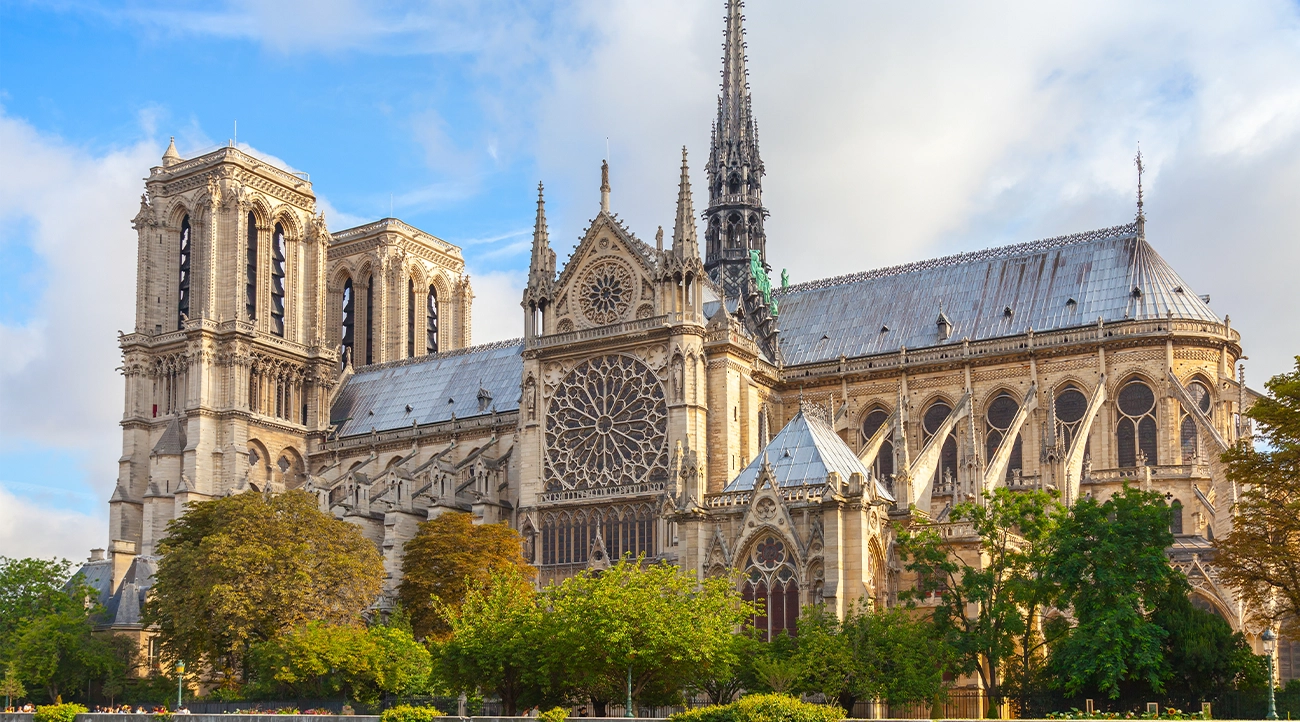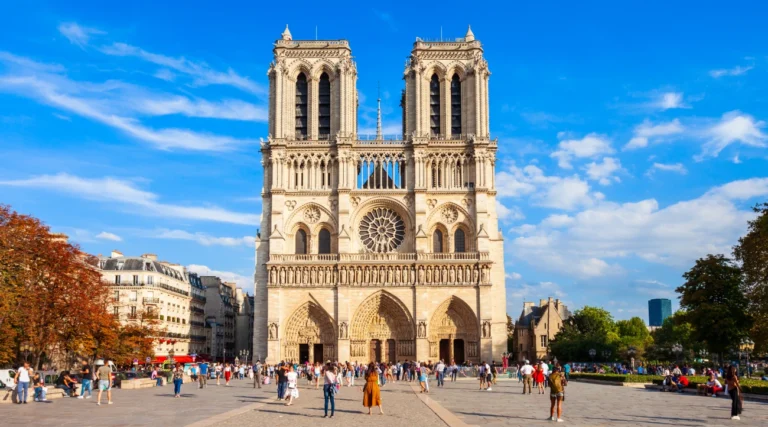


Notre-Dame: the queen of Parisian Gothic

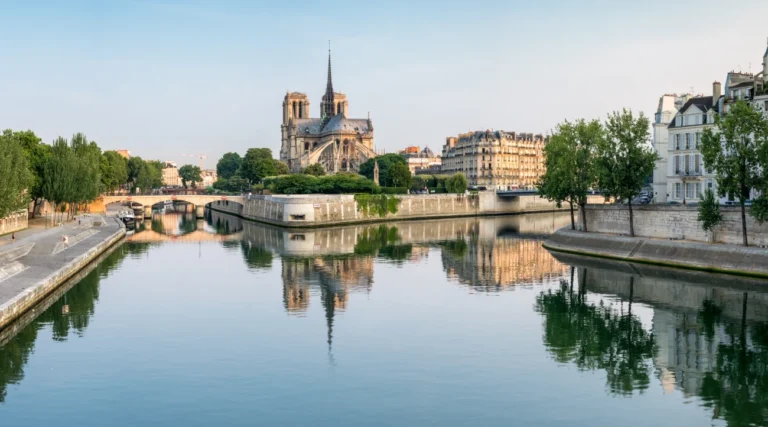
The beating and spiritual heart of Paris, rising majestically on the Île de la Cité, an absolute masterpiece of Gothic art and an eternal symbol of rebirth and resilience.

In short

Table of Contents

Notre-Dame opening hours and prices

Here's all the useful information about opening hours so you don't get caught unprepared in the churchyard. Remember that simple access to the Cathedral is absolutely free.

Times and masses

  • Mon - Fri 7:50 - 19:00

    Closes at 10pm on Thursday

  • Sat - Sun 08:15 - 19:30

    Last admission 30 minutes before

  • Masses from Monday to Saturday 8:00, 12:00, 18:00

    Rosaries, vespers and adorations are also planned

  • Sunday Masses 8:30, 10:00, 11:30, 18:00

    Lauds and vespers are also planned

What to see in Notre-Dame

Let yourself be overwhelmed by the majesty of a thousand-year-old sacred space where medieval stone meets the perfection of colored light.

1

Zero Point (Square in front) Curiosities

It is used as a reference for calculating distances to other cities in France

2

The three large historiated rose windows

Observe the monumental 13th-century glass circles that filter natural light.

3

The rebuilt Spire (Flèche)

Look skyward to admire the faithful reconstruction of the famous 19th-century wooden spire.

4

The Gargoyles and the Chimeras

Spot the iconic stone monsters watching over the city from the upper balustrades.

5

The Cathedral Treasury

Explore the internal exhibition space that houses the surviving sacred furnishings and liturgical objects.

The visit to Notre-Dame

Clear and concise guidelines to help you before queuing in front of the Île de la Cité.

How to visit Notre-Dame

Access to the cathedral is via the large pedestrian square in front (Place Jean-Paul II).

Powered by GetYourGuide

Need to know

  • The construction took almost two centuries, from 1163 to 1345.
  • Napoleon Bonaparte chose this cathedral to crown himself Emperor of the French in 1804.
  • The architect Eugène Viollet-le-Duc directed a massive restoration in the 19th century, inventing the famous chimeras.
  • The cross vault structure saved the building from collapse during the 2019 fire.

Practical advice

  • Download the cathedral's official app to your phone to monitor access in real time.
  • Keep an eye on your belongings in the churchyard outside: large crowds attract pickpockets.
  • Wear comfortable shoes: the pavement around the river island requires long stretches of walking.
  • Please remember that inside the nave it is mandatory to remove hats and maintain decorous behavior.

How to get to Notre-Dame

The cathedral stands on the Île de la Cité, in the geographical and historical heart of central Paris.
Metro

Line 4 stops at Cité station, a three-minute walk from the square. Alternatively, lines 1 and 11 stop at Hôtel de Ville, just across the bridge.

Rer

Lines B and C serve the Saint-Michel Notre-Dame station, whose entrances open on the opposite bank of the river.

Bus

Lines 21, 38, 47, 75 and 96 stop right in front of the monument or along the adjacent bridges.

Standing

Cross the Pont d'Arcole starting from the right bank or the Pont au Double arriving from the left bank.

6 Parvis Notre-Dame - Pl. Jean-Paul II, 75004

History of Notre Dame

In 1163, Bishop Maurice de Sully began construction of the immense new cathedral of Paris, demolishing the previous Merovingian basilica, which had become too small for the rapidly expanding city. The construction site became an immense medieval laboratory where the most innovative Gothic techniques were experimented with, such as the systematic use of flying buttresses to support the very high, thin walls.

Over the following centuries, the church was the setting for the nation's most important dynastic and political events. However, with the advent of the eighteenth century and Neoclassicism, tastes changed, and many medieval furnishings were removed or heavily altered. The hardest blow came with the French Revolution: the cathedral was ransacked, the statues of the kings on the façade beheaded by the mob, and the interior was used as a food storehouse and the Temple of Reason.

By the early 19th century, the cathedral was in a state of serious disrepair. It was saved by the 1831 publication of Victor Hugo's Notre-Dame de Paris, which moved public opinion and prompted the government to finance a colossal restoration project. The task was entrusted to the young architect Viollet-le-Duc, who rebuilt the central spire and added the famous sculptural arrangement of chimeras on the towers, defining the monument's Parisian image.

During the twentieth century, the cathedral survived both world wars unscathed, becoming the site of the celebration of the Liberation of Paris in 1944. On 15 April 2019, a devastating fire broke out in the attic, destroying the medieval wooden carpentry (the “forest”) and causing the nineteenth-century spire to collapse, keeping the entire world in suspense.

The response of the state and international donors sparked a reconstruction effort unprecedented in modern architectural history. Hundreds of artisans, carpenters, and restorers worked tirelessly to clean the blackened stones and faithfully reconstruct the collapsed structures, finally returning this immense universal heritage to the city and the entire world.

Curiosities about Notre-Dame

Notre Dame Tickets and Tours

Find accommodation near Notre-Dame

Don't have much time to scroll through the interactive map and see the features of each accommodation? Then read our quick guide to the best accommodations near Notre Dame.

Frequently Asked Questions

Is it mandatory to book online to enter, or can I just queue up?

Booking a time slot through the official app or website is highly recommended to avoid the miles-long lines in the churchyard, which can exceed two hours during peak season. Free spots are assigned on the spot, but waits can be very long.

Airport-style security checks with metal detectors are in place at the entrance . Small backpacks and personal bags are permitted, but bulky suitcases, trolleys, travel bags, or strollers are strictly prohibited. There is no storage or cloakroom service within themetro church

Yes, photography for strictly personal, non-profit purposes is permitted throughout the central nave and along the ambulatory. However, the use of flash, additional lights, tripods, or selfie sticks is strictly prohibited, to avoid damaging the materials and obstructing the constant flow of visitors.

Access to the upper towers and the Gallery of Chimeras requires a separate reservation from the church entrance. Attendance is limited due to the narrow medieval spiral staircases, and tickets are subject to limited daily availability.

The cathedral's colossal size makes it very difficult to fully heat the nave. In winter, the temperature inside is very similar to the outside, so it's recommended to keep coats, scarves, and gloves on throughout the visit to avoid feeling the cold. If you have concerns or concerns about cold temperatures, read our in-depth article on visiting Paris in winter.

Along the side aisles and near the chapels of the ambulatory, there are numerous metal displays containing traditional votive candles. You can take one by leaving a coin offering in the secure automatic drop-off boxes located next to the pews.

Yes, the main entrance on the western façade has no steps and a flat ramp that allows easy wheelchair access. The entire central nave and ambulatory are level and barrier-free, except for the underground archaeological routes and the climb to the towers.

The RER B and C station "Saint-Michel Notre-Dame" is located directly opposite the river island. Exiting the underground passages, simply cross the Pont au Double to find yourself on the main square in less than three minutes' walk.

Recommended Tickets and Tours for Paris Attractions

You might also be interested in...

The journey continues…

Bottom view of the Saint-Michel fountain
Aerial view of the area around the Louvre
Walt Disney Studios Tower in the background
View of the fountain in Place des Volgi in the Marais district
Grand Palais aerial view
Interior of the Foyer of the Palais Garnier

Activities and tours you can't miss

Share:
Previous
Louvre Museum: What to See and Tips for Visiting
Next
Saint-Germain-des-Prés: the oldest church in Paris