

In short
Designed in the late 18th century for the Duke of Chartres, Parc Monceau is one of the city's most elegant and unusual green oases . Its flower-filled and shady backdrop embraces a pond surrounded by an ancient colonnade, an Egyptian pyramid, and majestic centuries-old trees, offering a peaceful and cultured retreat.
Era: founded in 1778 (redesigned in 1861)
Amenities: Children's play areas, snack kiosks, public restrooms, children's cycle path, vintage carousel, and shaded benches.
Points of interest: the Naumachia with its Corinthian columns, the stone pyramid, the neoclassical rotunda of Ledoux, the Venetian bridge and the statues of great artists
Best time: in the morning, to stroll along the silent avenues frequented by the neighborhood residents
☰ Table of Contents
The ideal stop
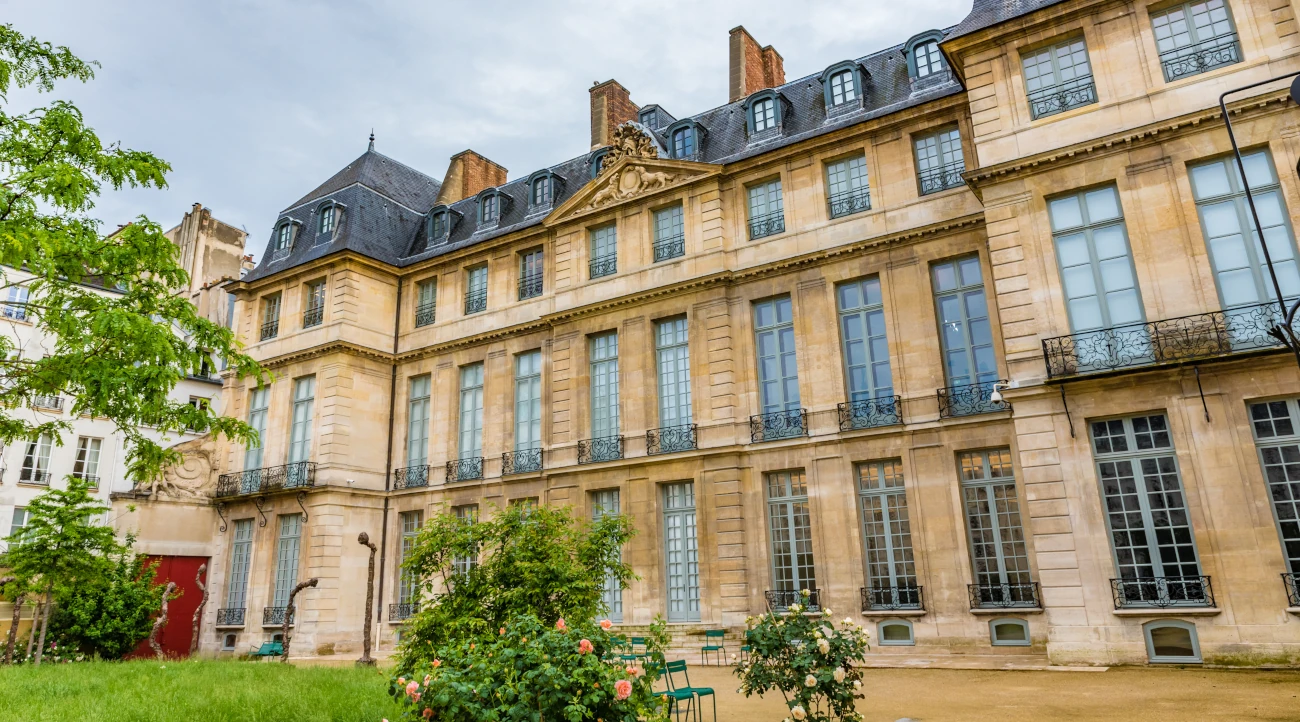
Ideal to combine with a visit to the splendid art collections of the nearby Cernuschi Museum or the Nissim de Camondo Museum.
-
Recommended parking time 40'
Forty minutes is enough to complete the circular route and photograph the ruins.
-
The local rite
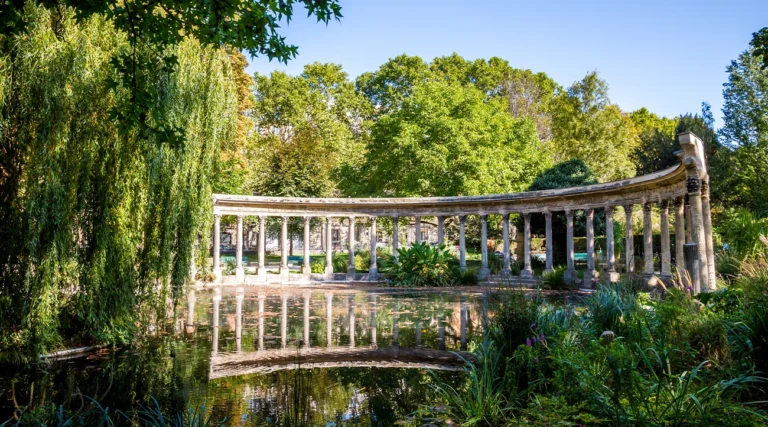
Sit on a bench in front of the Naumachia to watch the waterfowl and enjoy the quiet of the neighborhood.
What to see at Parc Monceau
Walk along the curving paths of this landscaped garden to discover architectural extravagances and monuments dedicated to the great geniuses of French art.
The Naumachia Not to be missed
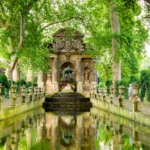
The suggestive oval body of water surrounded by a spectacular, partially submerged Corinthian colonnade, recovered from a demolished church.
The Egyptian pyramid
The bizarre little pyramidal stone structure that rises among the trees, a testament to the exotic fashion of the late eighteenth century.
The Rotunda of Chartres
Be struck by the neoclassical pavilion located at the main entrance, designed by architect Claude-Nicolas Ledoux as a former toll booth.
The Venetian Bridge
Discover the small, romantic stone passageway that spans the artificial stream, inspired by the historic bridges of the city of Venice.
Monuments to great writers
Explore the tree-lined avenues in search of the white marble sculptural groups dedicated to Guy de Maupassant, Frédéric Chopin, and Édouard Pailleron.
Visiting Parc Monceau
Navigating the tree-lined grounds of this historic private estate requires a few quick tips to help you experience the space in harmony with local customs.
Best moment
At nine in the morning, when the park is frequented only by joggers and residents walking.
Crowding
Moderate and very civilized during the week, livelier on weekend afternoons due to the presence of families.
Suitable for children
Yes, children really appreciate the historic carousel with horses and the equipped play areas.
What not to miss
The majestic hundred-year-old silver maple, whose monumental trunk exceeds four meters in circumference.
Type of experience
Refined, tranquil, romantic, bourgeois and full of curious, unconventional architectural discoveries.
What to expect
Strollers in motion, the elegance of the surrounding noble palaces, flowerbeds in bloom, and a profound sense of urban serenity.
How to visit Parc Monceau
We recommend crossing the monumental golden gate located in front of the Monceau metrostation. Proceed past the neoclassical roundabout and follow the main path clockwise to pass the naumachia, the pyramid, and the sculptural monuments in succession.
Need to know
- The Duke of Chartres wanted a garden full of illusions.
- The painter Louis Carrogis Carmontelle designed the fake historical ruins.
- The park hosted the first human parachute jump.
- Baron Haussmann reduced the size of the garden in the 19th century.
Practical advice
- Be careful of the lawns, which are only walkable in the very few permitted areas.
- Admire the pure gold details of the entrance gates.
- Photograph the columns at sunset for spectacular reflections.
- There are drinking fountains scattered along the avenues.
How to get to Parc Monceau
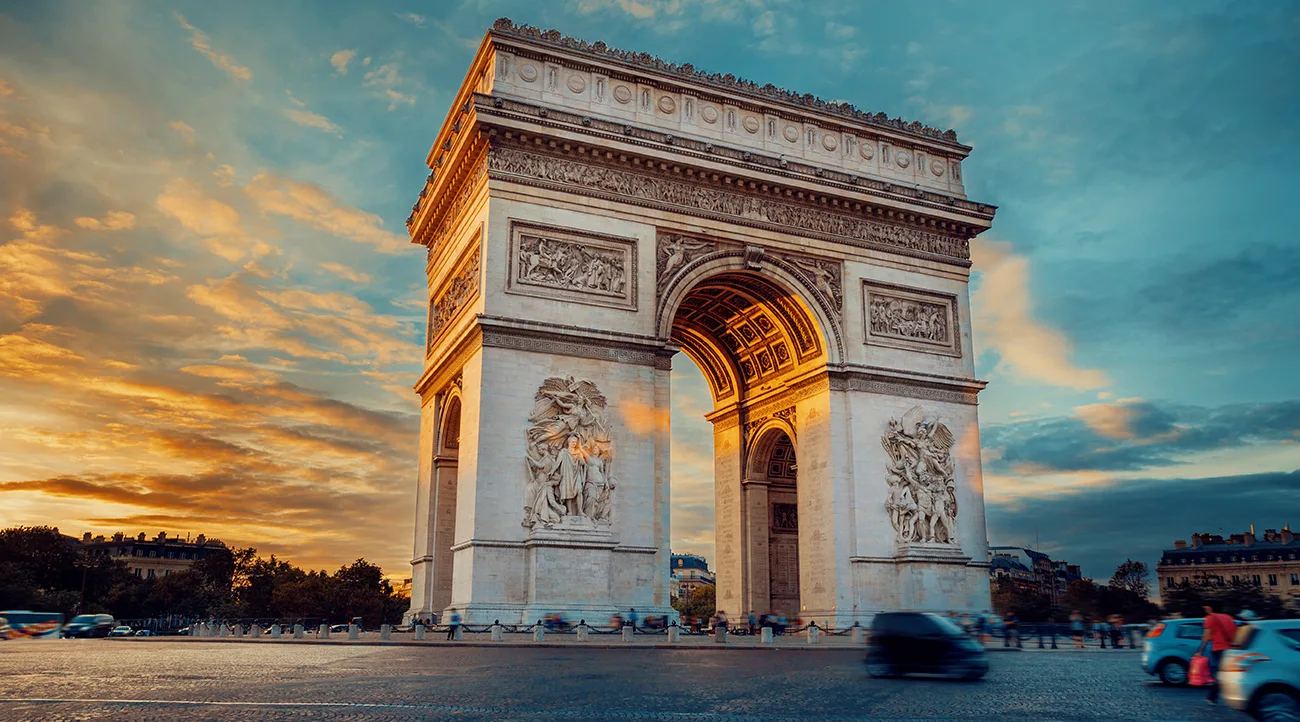
This elegant green space is located in the northern part of the eighth arrondissement, a short distance from theArc de Triomphe.
Line 2 stops exactly at Monceau station.
There is no RER stop nearby.
Lines 30, 84 and 93 make useful stops.
Walk along Boulevard de Courcelles heading east.
Parc Monceau, 75008
Official Transport Paris
- Paris Metro Map
- RER tickets and fares
- Taxis in Paris (numbers and alternatives)
History of Parc Monceau
In 1778, the wealthy and extravagant Louis-Philippe d'Orléans, Duke of Chartres, purchased a plot of land on the Monceau plain with the aim of creating a private garden that would break completely with the severe symmetry of the French parks then in vogue. He entrusted the project to the painter and writer Louis Carrogis Carmontelle, who conceived a "land of illusions": an eclectic space where different styles and eras blended to captivate the visitor, juxtaposing an Egyptian pyramid, a Dutch windmill, Roman ruins, and even Tartar tents.
Read moreShow less
Read moreShow less
With the outbreak of the French Revolution, the park was confiscated and nationalized, becoming the scene of an exceptional historical event in 1797: André-Jacques Garnerin made the first official flight in human history with a silk parachute, leaping from a hot air balloon and landing safely in the estate's meadows. Despite public interest, the area suffered years of progressive abandonment and partial plunder, only temporarily returning to the Orléans family during the years of the monarchical Restoration.
Its current form was defined in 1860, when the City of Paris purchased the property as part of the grandiose urban planning directed by Baron Haussmann. The state sold half the land to wealthy bankers and developers, who built the luxurious noble palaces that still surround the park's borders today. The remaining portion was transformed by engineer Jean-Charles Alphand into an English-style public garden, leveling the terrain, creating curved avenues, and connecting the surviving old architectural follies such as the naumachia.
The official inauguration took place in 1861 under the eyes of Emperor Napoleon III. From that moment on, the park became a favorite meeting place for the financial and artistic upper class, inspiring the paintings of great Impressionist masters such as Claude Monet with its lights and plants. Today, the structure retains this proud and peaceful character intact, offering a pristine glimpse of 19th-century Parisian elegance.
Curiosities about Parc Monceau
We tell you about the anecdotes that remain among the fake archaeological ruins of the garden of the eighth arrondissement.
The columns of the vanished church: the magnificent Corinthian colonnade surrounding the naumachia is not a 19th-century theatrical invention; the columns come from the monumental Rotunda of the Valois, an unfinished royal mausoleum built in Saint-Denis in the 16th century and demolished in the 18th century.
Palaces with secret entrances: many of the majestic and opulent private hotels bordering the park still have small private wrought iron gates that open directly onto the internal paths, allowing the owners to access the historic avenues bypassing the public road entrances.
A destroyed Chinese lantern: among the many extravagant attractions installed in the eighteenth century by the Duke of Chartres, a gigantic and colourful Chinese lantern in painted wood stood out, used as a tea kiosk, which was unfortunately destroyed during the riots of the revolutionary uprisings of 1789.
The giant oriental plane tree: near the small artificial stream stands a colossal specimen of the oriental plane tree, planted in 1814; its long, gnarled, curved branches grow horizontally until they almost touch the surface of the ground, requiring protective supports.
Tickets and tours nearby
Find accommodation near Parc Monceau
Let's explore together the best places to stay on the Champs-Eslysées, just steps from the Arc de Triomphe.
Frequently Asked Questions
Does the stone pyramid you see among the trees hold ancient tombs?
No, the pyramid is a purely decorative structure desired by the Duke as a stylistic quirk inspired by the archaeological discoveries of the time.
Can bicycles be rented on the park's pedestrian walkways?
No, adult bicycles are prohibited; only small bicycles and tricycles for small children are permitted in designated areas. Paris Bike Tours also cover other highlights.
Are the statues of musicians and writers original 19th-century works?
Yes, the white marble sculptures located along the paths are authentic celebratory monuments created by important French artists at the end of the century.
Is there underground parking near the entrances?
Yes, just below the northern section of Boulevard de Courcelles is a large paid underground public car park with exits near the gates.
Can you see the top of the Eiffel Tower while sitting near the central pond?
No, the dense vegetation of centuries-old trees and the height of the noble buildings along the perimeter block the view of the distant monuments of the city.
Is the water flowing in the artificial stream inhabited by fish or turtles?
Yes, the waters of the small canal and the naumachia are home to numerous carp and ducks, protected and cared for by the municipal gardeners.
Does the park host outdoor art shows or markets throughout the year?
The external gates sometimes host temporary photographic exhibitions, but the interior of the park remains reserved exclusively for walking and relaxation.
Are dogs allowed on the trails on a short leash?
Dogs are not allowed throughout the historic garden to protect the cleanliness of the gravel paths and the safety of children.