

Parc des Buttes-Chaumont: one of the most beautiful parks in Paris

A surprising and spectacular 19th-century green lung that breaks the classic Parisian linearity between imposing rocky cliffs, suspension bridges and artificial caves.
In short

Table of Contents

The ideal stop

Combine it with a bohemian stroll through the hidden streets of nearby Belleville Hill.

  • Recommended parking time 90'

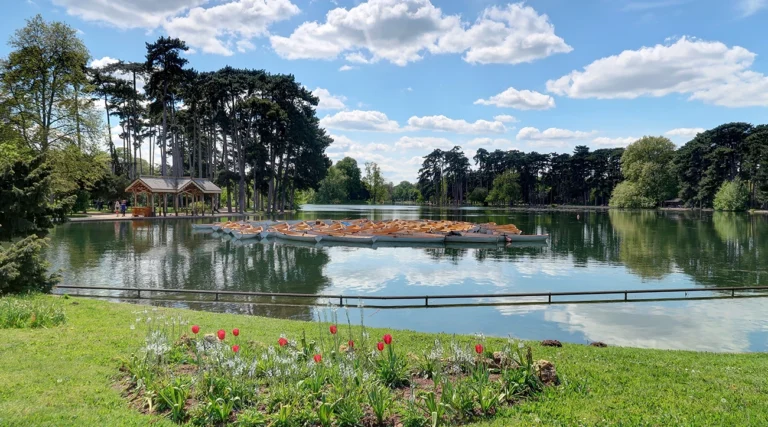
    An hour and a half allows you to climb the cliff and make a complete tour of the lake.

  • The local rite

    Spread a blanket on the steep lawns of the park to enjoy an impromptu aperitif of baguettes and cheese with the residents.

What to see at the Buttes Chaumont Park

Venture along the walkways of this monumental feat of landscape engineering to discover romantic views and bold architectural installations.

1

The Temple of the Sibyl Focal point

Admire the elegant neoclassical kiosk that stands on the top of the cliff, directly inspired by the famous Temple of Vesta located in Tivoli.

2

The suspension bridge

Observe the sixty-five-meter-long metal walkway that spans the pond, designed by the engineering genius Gustave Eiffel.

3

The large artificial cave

Be amazed by the imposing fourteen-meter-high cave, decorated with fake stalactites and cooled by a thunderous internal waterfall.

4

Belvedere Island

Explore the imposing thirty-meter-high limestone outcrop that emerges from the center of the reservoir, reached via pedestrian bridges.

5

The old railway line

Discover the abandoned tracks of the Petite Ceinture that cut through a portion of the park, now an evocative corridor of plant biodiversity.

Visiting the Buttes Chaumont Park

Walking through this mountain landscape requires a bit of energy and some caution to deal with the steep slopes.

How to visit the Buttes Chaumont Park

We recommend entering through the main entrance located opposite the 19th arrondissement town hall. For guided tours and experiences, check the calendar:

Need to know

  • The land was home to ancient chalk and clay quarries.
  • The area also served as the capital's municipal landfill.
  • Baron Haussmann chose to redevelop this degraded area.
  • Jean-Charles Alphand designed the space imitating a mountain landscape.

Practical advice

  • Wear sneakers for climbing hills.
  • Avoid isolated areas during sunset hours.
  • The lawns are accessible, great for lying down in the summer.
  • Check the location of the attractions in this guide before going there, optimizing your experience.

How to get to the Buttes Chaumont Park

You'll find this immense green lung in the north-eastern part of Paris, well connected by public transport.

Metro

Line 7bis stops at the Buttes Chaumont and Botzaris stations.

Rer

There are no RER lines in the immediate vicinity of the Park.

Bus

Lines 26, 48, 60 and 71 make useful stops.

Standing

Walk north up the lively Rue de Belleville

Av. de la Cascade, 75019

History of the Buttes Chaumont Park

Until the mid-19th century, this part of the Parisian suburbs was a bleak, barren, and feared place. Its original name, "Mont-Chauve" (bald mountain), referred to the total absence of vegetation, due to the presence of enormous underground quarries from which chalk was extracted to build the city center's buildings. In addition to the mines, the area had been used for centuries as the site of the sinister Montfaucon gallows and, later, as a garbage dump and a huge storage area for horse carcasses, making the air unbreathable.

In 1860, with the annexation of the outskirts of the city, Emperor Napoleon III decided to radically transform this urban scourge into a large public park for the area's working class. The ambitious project was entrusted to engineer Jean-Charles Alphand, who faced a colossal technical challenge: the sinkholes had to be filled, the unsafe underground tunnels had to be reinforced, and thousands of tons of fertile soil had to be brought in to allow trees to grow.

Alphand decided not to erase the site's industrial past, but to exploit the vertical walls of the old quarries to invent an artificial and romantic mountain landscape. A large lake was dug, fed by the Ourcq Canal, the crumbling rock faces were reinforced with spectacular concrete facings that mimicked natural cliffs, and thousands of exotic trees were planted. Gustave Eiffel was called upon to design the daring iron suspension bridge.

The park was officially inaugurated in 1867, coinciding with the Universal Exhibition, astonishing citizens with its spectacular and theatrical character. During the tragic days of the Paris Commune of 1871, the Buttes-Chaumont were the scene of the last, bloody clashes between the revolutionaries and the regular army. Today, the park has regained its peaceful soul and remains one of the world's masterpieces of 19th-century engineering.

Curiosities about the Buttes Chaumont Park

Tickets and tours nearby

Find accommodation near the Buttes Chaumont Park

Being slightly away from the center, the Park area is one of the best places to stay for those on a budget.

Frequently Asked Questions

Is the Temple of the Sibyl an authentic Roman ruin brought from Italy?

No, it is an eclectic reproduction designed by architect Gabriel Davioud, built entirely of Paris stone in the mid-nineteenth century.

No, swimming is strictly prohibited anywhere in the body of water, both for safety reasons and to protect the ecosystem. If you're looking for more refreshing experiences, we'll tell you about them in Paris in August.

No, the electric pumps that push the water upwards are turned off in the evening when the gates close and reactivated the next morning.

The park is almost entirely sloped, but the paved loop that circles the base of the lake is the most accessible and least steep trail.

Yes, the park is home to the famous Rosa Bonheur, a historic pavilion transformed into a popular modern guinguette where people dance and dine.

Water is pumped directly from the nearby Ourcq Canal through a dedicated hydraulic network designed in the 19th century.

No, the lake's conformation and currents do not allow for the rental of wooden boats for children.

Yes, the management closes the gates in case of severe frost because the steep asphalt paths become slippery and dangerous for passers-by.

Must-See Tickets and Tours in Paris

You might also be interested in...

The journey continues…

Tourist in front of the Water Lilies Orangerie Museum
Montmartre Funicular with the Sacré-Coeur Basilica in the background
Aerial view of the Latin Quarter
Place Vendome aerial view
Bridge over the Canal Saint-Martin in Paris
Café in Paris with flowers and fuchsia tables

Activities and tours you can't miss

Share:
Previous
Champ de Mars: the park of the Eiffel Tower
Next
Versailles Palace Tickets: Entrances, Passes, and Guided Tours