

In short
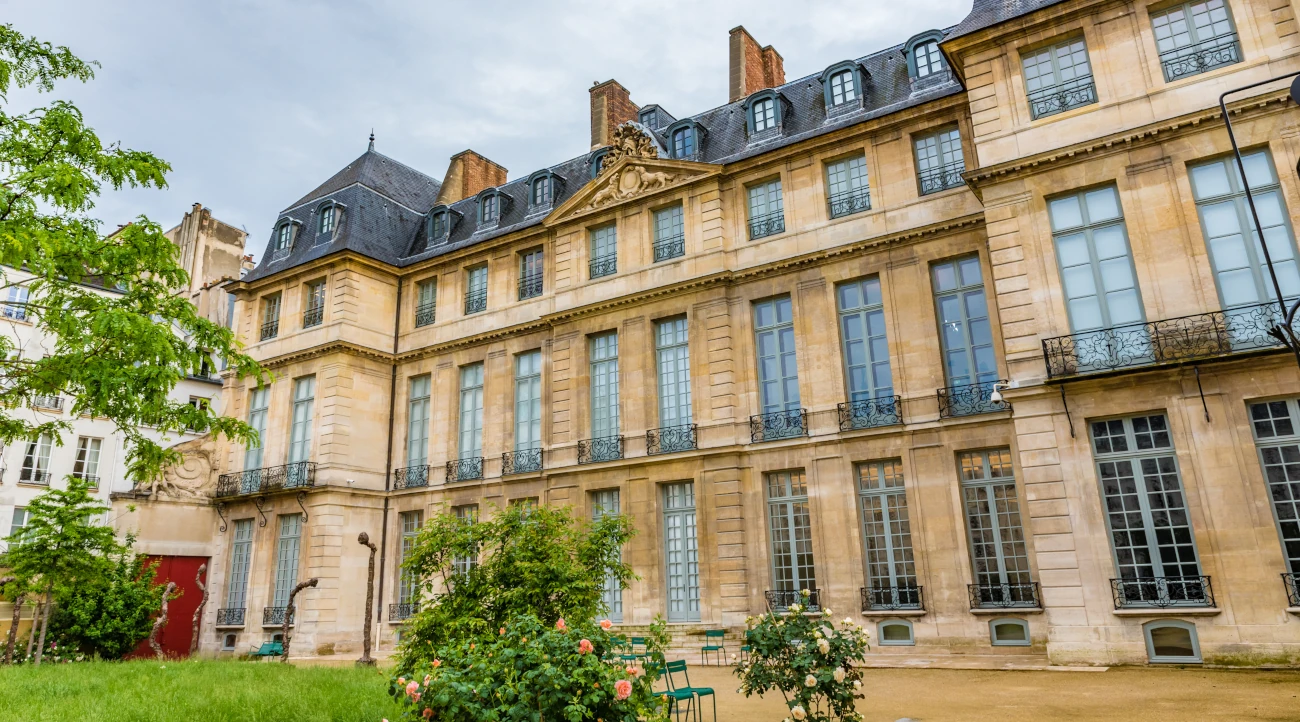
Located in the heart of the charming Marais district , the Picasso Museum houses the world's largest collection of works by the Spanish master. The contrast between the 17th-century mirrors in the rooms and the explosive force of the Cubist canvases offers a unique exhibition experience, enriched by the artist's personal archives and his private collection.
Period: founded in 1985 (building from 1659)
Architecture: Baroque and Classical
Artistic movements: Cubism, Blue Period, Rose Period, Classicism and Surrealism
Best time: Early afternoon on weekdays
☰ Table of Contents
Picasso Museum Opening Hours and Prices
Plan your visit to the heart of the Marais by checking museum ticket prices and special evening openings dedicated to the Cubist master's major temporary exhibitions.
Opening hours
-
Tue - Sun 09:30 - 18:00
Last admission 45 minutes before
-
Ordinary closures
Every Monday, January 1st, May 1st, December 25th
Prices
-
Full price from €16
-
Reduced 12€
Family rate
-
Free entry Free
Minors under 18, disabled people with companion, EU Under 26s
What to see at the Picasso Museum
Let yourself be guided through the sumptuous halls of the Hôtel Salé to discover the incredible stylistic evolution of an artist who reinvented form, space, and color in the twentieth century.
The Self-Portrait of the Blue Period Most requested
Admire the famous 1901 canvas imbued with melancholy and cold shades.
The Celestina
Observe the magnetic monochrome portrait that marks the pinnacle of the artist's early production.
Women at the fountain
Let yourself be struck by the return to order and the monumental and classical forms of the 1920s.
The Revolution of Cubism Not to be missed
Explore the rooms dedicated to geometric decomposition, filled with iconic works such as The Young Painter, the study for Les Demoiselles d'Avignon and the complex assemblages in wood and metal.
Pablo's private collection
Discover the artist's treasured personal paintings, signed by friends and masters such as Henri Matisse, Paul Cézanne, Edgar Degas, and Douanier Rousseau.
Visiting the Picasso Museum
Use these quick and easy tips to navigate security checks and move comfortably between the various floors of this opulent noble residence.
Best moment
At two o'clock to avoid the morning school groups.
Crowding
Fluid in stable rooms, more intense in temporary sectors.
Suitable for children
In part, the whimsical sculptures made from recycled materials really impress them.
What not to miss
The bronze chandeliers and furnishings designed by Diego Giacometti.
Type of experience
Intense, stimulating, rich in visual contrasts and geometric discoveries.
What to expect
Monumental staircases, decorated ceilings and numerous graphic masterpieces.
How to visit the Picasso Museum
The museum is accessed through the historic main entrance on Rue de Thorigny. The exhibition extends over four floors, connected by a grand Baroque staircase, from his early works to his most recent productions.
Need to know
- The building is called Hôtel Salé because the owner collected the salt tax.
- The collection was born thanks to the dazione, a tax paid with works of art.
- The French state thus inherited thousands of unique pieces.
- The museum also houses all the original drawing notebooks.
Practical advice
- Book your slot online a few days in advance.
- Use the internal elevator if you have difficulty with the historic stairs.
- Leave bulky coats in the free storage spaces on the ground floor.
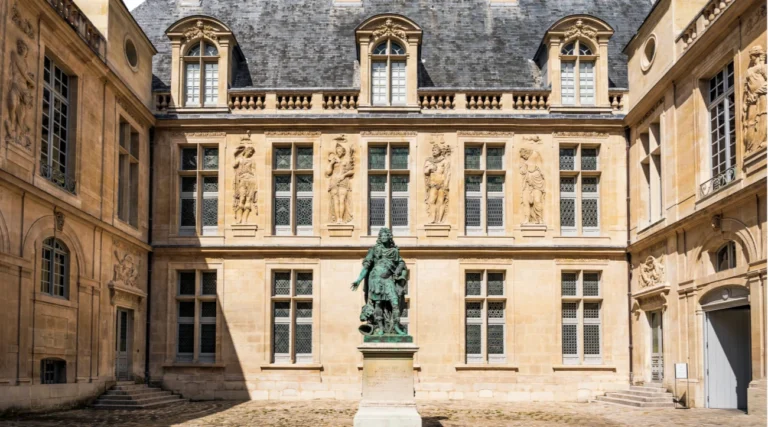
- Photograph the courtyard of honor from the first floor windows.
How to get to the Picasso Museum
The museum is located in the heart of the third arrondissement, in the famous Marais district.
Line 1 stops at Saint-Paul, line 8 at Chemin Vert.
The Châtelet - Les Halles stop is about a fifteen-minute walk away.
Lines 29, 69, 75 and 96 stop in the immediate vicinity.
Go along Rue de Turenne and then turn off at Rue de Perle.
5 Rue de Thorigny, 75003
Official Transport Paris
- Paris Metro Map
- RER tickets and fares
- Taxis in Paris (numbers and alternatives)
History of the Picasso Museum
In 1659, architect Jean Boullier completed construction of the Hôtel Salé for Pierre Aubert, a wealthy bourgeois who had become enormously wealthy by managing the contract for the gabelle, the infamous and hated state tax on salt. The palace immediately became one of the grandest and most eclectic examples of Baroque architecture in the Marais district, characterized by an immense grand staircase carved from stone and richly decorated stucco ceilings. Over the centuries, the residence changed owners, housing the Venetian embassy, schools, and even artisan workshops.
Read moreShow less
Read moreShow less
In the twentieth century, the palace came under the ownership of the City of Paris, which decided to completely restore it and dedicate it to cultural use. The turning point came in 1973, the year of Pablo Picasso's death . The artist had left no written will, and to resolve the complex issue of inheritance tax, his heirs decided to avail themselves of the law of dation. This law allowed inheritance taxes to be paid to the state by donating works of art of exceptional historical value.
The French government thus selected an immense collection of paintings, sculptures, ceramics, and drawings spanning every moment of the Spanish master's long career. The Hôtel Salé was chosen as the ideal venue to house this immense national treasure, initiating a delicate interior restoration project to adapt the ancient Baroque rooms to the stringent security and lighting requirements of a modern public gallery.
The Picasso Museum was officially inaugurated in 1985, immediately gaining international success. In the 2000s, the facility underwent a major renovation that allowed the administrative offices to be moved to an external building, freeing up the entire surface area of the historic building and doubling the space available for visitors to admire the works of art.
Curiosities about the Picasso Museum
Interesting and little-known information about the Picasso Museum.
The hidden sculpture: in the garden behind the building there is a monumental bronze sculpture that Picasso created during the years of the Second World War.
An endless inventory: the artist never threw anything away. The museum's storage rooms even contain old train tickets, postcards, and newspaper clippings he used for collages.
Designer chandeliers: all the lighting fixtures, lamps, and benches you find in the exhibition rooms were specially created by the artist Diego Giacometti, brother of the famous sculptor Alberto.
The Bull's Heads: Among the most famous sculptures on display, you can admire a bull's head created by simply joining together an old bicycle saddle and handlebars found on the street.
Picasso Museum Tickets and Tours
Find accommodation near the Picasso Museum
You can search for the hotel that suits you among the best accommodations in Marais.
Frequently Asked Questions
Are the most famous works like Guernica found in this museum?
No, the monumental painting Guernica is kept at the Reina Sofía Museum in Madrid, Spain.
Can we also admire the ceramics created by Picasso?
Yes, the museum displays a rich collection of terracotta plates, vases, and sculptures made in Vallauris.
Is there an internal garden where I can rest?
Yes, the building overlooks an internal courtyard and a back garden where there are some sculptures.
Is the museum accessible during heavy rain?
Yes, the entire exhibition takes place within the covered rooms of the historic noble palace. Discover other things to do in Paris in the rain.
Is there a combined ticket with Victor Hugo's house?
No, they are two museums run by different organizations, but Hugo's house is just a few minutes' walk away.
Can I take a photo of the portraits in the private collection?
Yes, photography for personal use is free everywhere, as long as you never use flash.
Is the Paris Museum Pass accepted at the entrance?
Yes, the pass is valid , but you still need to book your access time slot on the website.
Is there a rooftop bar?
Yes, on the terrace of the Hôtel Salé there is a small café open during the summer.