

















































In short
The RER is the ideal complement to the metrometro getting around Paris, essential both for crossing the historic center in just a few minutes (thanks to a limited number of stops) and for reaching major destinations outside the city center located in the outer fare zones.
- Strategic Speed: Fewer stops to quickly get through the center.
- Extra-urban radius: Connects the center to zones 3 to 5.
- Key routes: Reaches Versailles, Disneyland and the two airports.
- Fare integration: Use the metro in zone 1.
☰ Table of Contents
Things to know about the Paris RER
Taking the RER is simple, but requires much more attention than the metro(find out the differences) due to extra-urban fares and multi-destination trains.
Urban integration
Within zone 1 (central Paris), the RER works exactly like the metro and the same standard ticket is used.
Out-of-town rates
If you travel beyond zone 1, the single urban ticket is no longer valid and a specific "Origine-Destination" ticket is required.
Indicator boards
On the platforms, illuminated monitors indicate with a lit square the specific stations where the arriving train will stop.
Double validation
The RER ticket must be inserted at the turnstiles both to enter the station and, mandatory, to exit at the destination gates.
Branching lines
The RER lines are divided into several peripheral branches (e.g. C1, C5): always check the terminus printed on the front of the train.
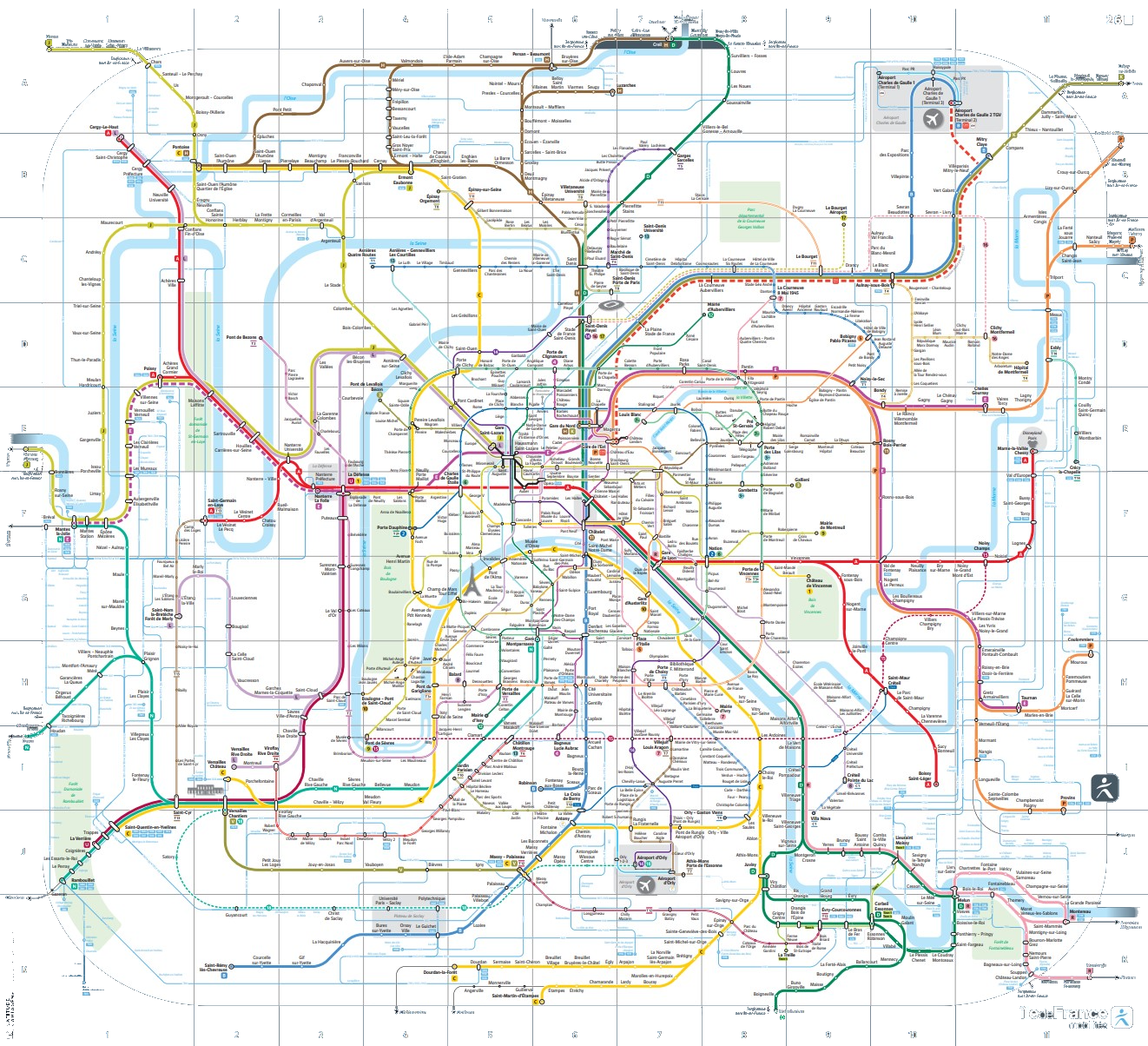
Paris RER Map
The RER network cuts across the city geometrically from north to south and from east to west, connecting to every major station and major metrointerchange hub.
Quick tip
Always check the SIEL monitors on the platform before boarding: the same platform hosts trains headed to completely opposite peripheral termini.
Download the official map
Official RATP map of the Paris Metro, RER and Tram network.
High-resolution PDF format
Ideal for printing or offline viewing
Always updated
Official RATP Edition
Complete with legend
All Metro, RER and Tram lines
Official source: RATP Paris • All rights reserved
How to use the map
Find your departure station
Follow the color of the line
Count the stops for your route
Plan your trips
The most useful lines for tourists
Although the entire network covers hundreds of suburban towns, three specific RER lines are the true arteries of Parisian tourism.
| Line | Color | Useful for reaching | Ideal for |
|---|---|---|---|
| TO | Red | Disneyland Paris, Châtelet-Les Halles, Gare de Lyon, La Défense | fun and shopping |
| B | Blue | CDG Airport, Orly Airport, Gare du Nord, Saint-Michel | airport connections |
| C | Yellow | Palace of Versailles, Invalides, Eiffel Tower, Musée d'Orsay | palaces and large museums |
Which ticket should I choose?
Depending on whether you need to stay in the city center or reach the parks and palaces on the outskirts, the choice of RER travel ticket changes radically.
t+ ticket
Ideal for: RER routes in the city centre.
- valid only in Zone 1
- allows changes metroand RER
- use identical to the metro
Ile-de-France Ticket
Ideal for: specific extra-urban destinations.
- point-to-point fare
- price calculated on distance
- necessary for Versailles or Disney
Paris Visite (Zones 1-5)
Ideal for: total travel and airports.
- unlimited travel anywhere
- includes RER to airports
- no extra charge required
I'm sailing Week (1-5)
Ideal for: a full week of travel.
- covers all RER lines
- super convenient subscription
- valid Monday-Sunday
Quick tip
If you use a single paper ticket for Versailles or Disneyland, buy a double one (round trip) immediately to avoid miles of queues at the ticket office in the evening.
The most popular tourist passes in Paris
Passes like the Paris Visite or Navigo loaded for all zones allow you to board any RER train without having to worry about calculating fares at the arrival stations.
Need to know
- RER trains are much larger than metrotrains and are almost all double-decker.
- The urban RER stations are directly connected to the metro stations of the same name.
- A ride on the RER from one end of central Paris to the other takes less than half the time of the metro.
- “Billet Île-de-France” tickets are valid in both directions of the purchased route, but for a single journey only.
Practical advice
- Never get off the RER train if you don't see the name of your stop illuminated on the onboard display boards.
- Keep your ticket in your pocket: if you lose it or it becomes demagnetized, you won't be able to get through the RER exit turnstiles.
- Trains marked “Direct” skip intermediate stations to get you to the airports faster.
- In the outer peripheral stations, train frequencies may be reduced to one passage every 15-20 minutes.
History and curiosities of the Paris RER
The RER network was inaugurated in 1969 to connect the center of Paris to the rapidly growing suburbs, integrating seamlessly with the metroexisting 250 stations and hundreds of kilometers of track, it today represents the essential infrastructure for daily commuters and for out-of-town tourism.
- It was born in 1969: the first route connected Nation to Boissy-Saint-Léger.
- The trains are double-decker: the large influx of passengers requires very high-capacity carriages.
- It runs through the city underground: in the center it works like a metro .
- The stations are monumental: the underground platforms are much longer and deeper.
- Line A is the busiest: it carries more than a million passengers a day.
- It was born from old railway lines: many external sections already existed in the nineteenth century.
- The name was chosen as an acronym: it means réseau express régional.
- It revolutionized Parisian transport: it connected the suburbs directly to each other for the first time.
Metro or RER? Which should I use?
When planning a stay in Paris, one of the first challenges you'll face is choosing public transportation, specifically the difference between the metroand the RER network. Although both systems constantly intersect underground in the capital and often use the same tickets for central routes, they are very different in terms of travel logic, speed, and destinations.
| Metro | RER |
|---|---|
| Ideal for getting around the centre of Paris | Ideal for longer routes and regional connections |
| Many stops close together | Fewer stops, but faster travel |
| Perfect for reaching central attractions | Useful for airports, Versailles and Disneyland |
| Easier for daily tourist travel | More useful when you need to leave the city center |
Frequently Asked Questions
Can I use the t+ ticket on the RER to go to the Palace of Versailles?
No, Versailles is in zone 4. Using a t+ urban ticket will expose you to a certain fine at the exit turnstiles.
What do the four-letter codes (e.g., VICK, GATA) on the RER display boards mean?
These are the “mission codes”: each code uniquely identifies the destination station and the type of intermediate stops made by the train.
Do children pay full fares on RER trains?
Children under 4 travel free, while those aged 4 to 11 are entitled to reduced fares. Discover all the secrets for visiting Paris with children.
Does the RER B line go directly into the terminals at Charles de Gaulle Airport?
Yes, it makes direct stops at both Terminal 3 (Roissypole) and Terminal 2, then connecting to the free internal CDGVAL trains.
Is there a price difference if I buy the RER ticket at the station or on the website?
The prices of single regional tickets are fixed and identical whether purchased at automatic ticket machines or via digital channels.
Do RER trains run as frequently as the regular metro?
In central Paris, train frequencies are very close together, while on the outer peripheral branches, waits can vary between 10 and 20 minutes.
Can I take my bicycle on board the RER carriages?
Yes, bicycle transport is free but only permitted on weekends and holidays, or during off-peak hours.
How do I know if an RER C train is going to Versailles or somewhere else?
You need to check the monitors on the platform and make sure the light next to the “Versailles Château Rive Gauche” station comes on.
Do Navigo Easy passes support suburban RER tickets to Disneyland?
No, at the moment only t+ city tickets and airport bus tickets can be loaded onto the Navigo Easy card.
Do RER subways remain open during general strike days?
In the event of a strike, service is reduced; the minimum guaranteed timetables and active trains are communicated the day before on the RATP website.