

In short
Overlooking the Seine, the Conciergerie is a monumental complex that holds centuries of power and historical drama.
-
Period: 14th century
-
Architecture: Gothic
-
Function: former royal palace and prison
-
Best time: early morning
☰ Table of Contents
Concierge Hours and Prices
Those wishing to explore the Gothic halls and revolutionary prisons can check opening days and current prices here.
Opening hours
-
Everyday 9.30-18.00
-
Last access 30 minutes before
-
Ordinary closures
May 1st and December 25th
Prices
-
Adults from €13
-
Youth (18–25) Free
-
Free entry Free
Minors under 18, disabled people with companion
What to see at the Conciergerie
Exploring these ancient palaces takes you on a journey that combines the magnificence of kings with the cruelty of revolutionary trials.
Hall of the Gens d'Armes
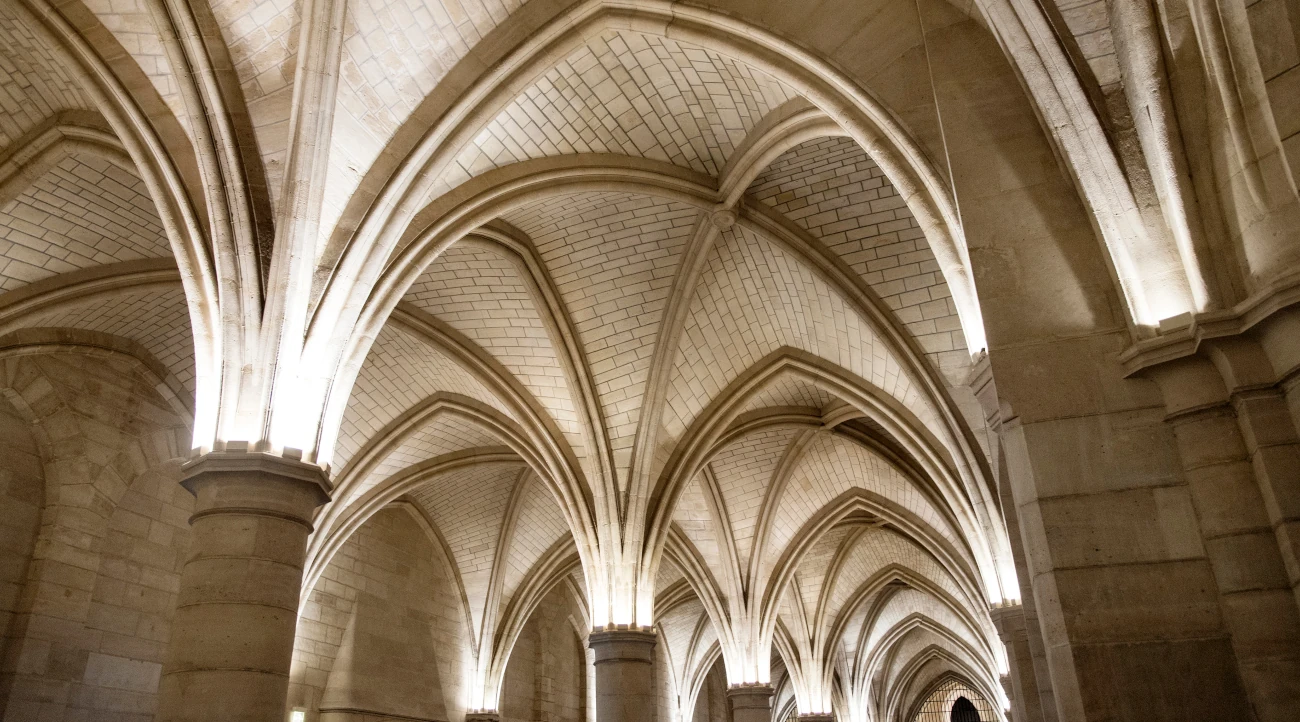
It is the largest Gothic civil hall in medieval Europe, an imposing space that once hosted royal banquets.
Guard Room
This space served as an antechamber to the great moments of court life, and still retains an austere and solemn atmosphere today.
Marie Antoinette's Cell Historical Detail
A moving historical reconstruction that allows us to understand the queen's last hours before the guillotine.
The Conciergerie Chapel
A place of intimate reflection, where prisoners sentenced to death awaited their final fate.
The internal courtyards
A glimpse into the daily lives of prisoners, amidst restrictions and the ruthless prison system of the revolutionary era.
The visit to the Conciergerie
The site's evocative atmosphere can vary depending on the traffic. Here's some useful information to help you make the most of your time.
Best moment
Crowding
Suitable for children
Yes, the historical trail offers interesting educational ideas even for the little ones.
What not to miss
The digital reconstruction allows us to view the original appearance of some missing rooms.
Type of experience
Historic, solemn and immersive, dedicated to the key moments of the Revolution.
Useful note
Stone rooms, shadowy corridors and a historical narrative full of meaning.
How to visit the Conciergerie
Several online solutions allow you to simplify entry and dedicate yourself entirely to exploring the rooms.
Need to know
- The monument is part of the Conciergerie and Sainte-Chapelle complex, which can often be visited with a single ticket.
- It is a place that requires a respectful attitude given its dramatic history.
- Historical reconstructions are essential to understanding the dynamics of the prison.
- The temperature inside can be cool even during the summer.
Practical advice
- Book tickets in advance to avoid long waits in sun or rain.
- The original stone floor requires careful walking.
- Consider dedicating about an hour and a half to the complete visit.
- Bring a camera to capture the cross vaults, but remember to turn off the flash.
How to get to the Conciergerie
The complex is located on the Île de la Cité, in the heart of Paris. Visiting it is an excellent opportunity to admire the historic center.
Line 4 stops at Cité station, located a few steps from the entrance.
Lines B or C arrive at the Saint-Michel Notre-Dame station, a few minutes' walk away.
Several lines, such as 21, 27, 38 or 85, connect the area with the main points of the city.
Crossing one of the bridges leading to the Île de la Cité is the most charming way to reach the site.
2 Bd du Palais, 75001
Official Transport Paris
- Paris Metro Map
- RER tickets and fares
- Taxis in Paris (numbers and alternatives)
History of the Conciergerie
The construction dates back to the Middle Ages, when the site served as the primary residence of the sovereigns of France. In the 14th century, under the reign of Philip the Fair, the palace was expanded to accommodate court life and royal administration.
Read moreShow less
Read moreShow less
As time passed, the royal family decided to move elsewhere, transforming the palace into a government facility. The "Concierge," a highly powerful figure appointed by the king, took over its management, giving the entire complex its current name.
During the French Revolution, the building underwent a dramatic transformation, becoming the main prison of the Revolutionary Tribunal. High-ranking figures, intellectuals, and ordinary citizens were locked up here, awaiting trial, which almost always resulted in the guillotine.
The climate of terror that raged in Paris transformed the luxurious Gothic halls into damp, overcrowded cells. The prison was run ruthlessly, with prisoners divided according to their financial means and social rank.
Marie Antoinette remained within these walls for over two months in harsh prison conditions. Her cell, transformed into a chapel after the restoration of the monarchy, remains today the most vivid testimony to the end of the era of kings.
Today, the monument is protected as a national treasure and serves as a museum of French judicial history. Millions of people walk these corridors every year, keeping alive the memory of the momentous events that forever changed the face of France.
Curiosities about the Conciergerie
Behind the medieval walls lie details that amaze with their unique history.
- The Revolutionary Tribunal: It is estimated that over 2,700 people were sentenced to death from here.
- The Hall of Men-at-Arms: was used by over 2,000 members of the court staff.
- Historic clock: on the external facade is the first public clock in Paris, installed in 1370.
- The name: derives from the office of the “Concierge”, who managed royal justice and the surveillance of prisoners.
Conciergerie tickets and tours
Find accommodation near the Conciergerie
Using this map, you can easily find the right accommodation for you near Ile de la Cite.
Frequently Asked Questions
Is it necessary to book the visit in advance?
It is highly recommended to ensure entry and skip the ticket line.
Can you visit Marie Antoinette's prisons?
Yes, the reconstruction of his cell is included in the museum itinerary.
Is the site accessible to people with reduced mobility?
Yes, most of the trail is equipped to ensure access.
Do you pay to enter the Conciergerie?
Entrance is subject to a fee, with discounts available for various categories.
What is the nearest metro station?
The Cité stop (line 4) is the most convenient for those arriving by metro.
Can you take photos inside?
Yes, personal photographs are permitted, as long as you do not use flash.
How long does it take to see everything?
Allow about 60-90 minutes to enjoy the entire historical route.
Is it possible to get a cumulative ticket?
Yes, a combined ticket for the Conciergerie and Sainte-Chapelle is often available.