Home » Getting Around » Taxis in Paris: Fixed Rates, Apps, and Helpful Tips
Taxis in Paris: Fixed Fares, Apps, and Helpful Tips
Taking a taxi in Paris is a convenient, safe, and highly regulated option, especially ideal for nighttime travel or when traveling with heavy luggage to the airport.
Getting around Paris by taxi offers a higher level of comfort than mass transit, allowing you to reach your destination directly and without architectural barriers. Thanks to dedicated preferential lanes, taxis are often able to avoid the heaviest traffic jams.
Fixed airport fares: Prices to and from major airports are fixed and transparent.
Dedicated preferential lanes: authorized vehicles travel in the same lanes reserved for buses.
Traceable payments: each vehicle must guarantee the functioning of electronic payments.
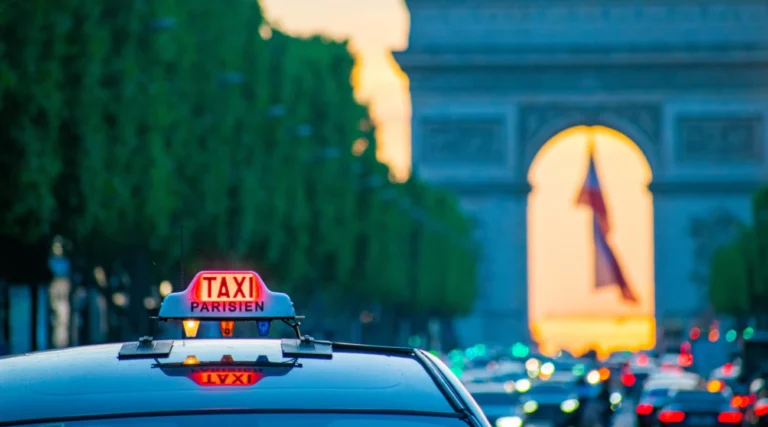
Extensive official fleet: over 18,000 cars marked with the illuminated sign on the roof.
☰ Table of Contents
Things to Know About Taxis in Paris
The Parisian public taxi service follows strict rules established by the Prefecture of Police to protect passengers and ensure price transparency.
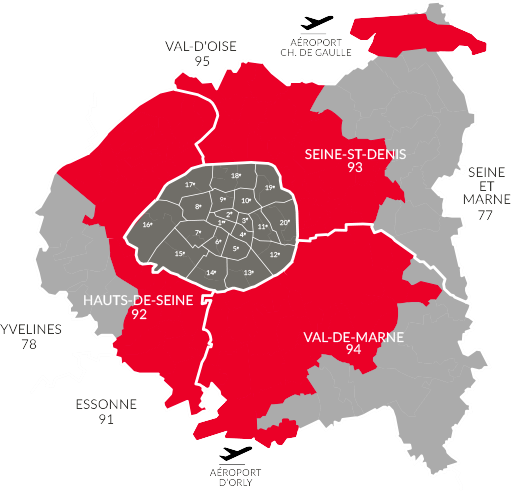
It's not always easy to hail a taxi on the street in the city center, but the capital is dotted with dedicated taxi ranks. Below, you can see the breakdown of Paris and its surrounding areas into fare zones: depending on the time of day and day of the week, each zone has a per-kilometer rate (A: €1.30, B: €1.66, C: €1.76).
To call or book an official taxi in Paris, the most popular and secure app is G7 Taxi, which allows you to track your vehicle in real time and pay directly via smartphone.
Fixed fares for airports
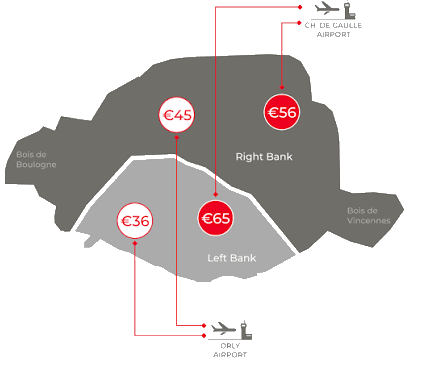
One of the main advantages of the Parisian public transport system is the presence of fixed fares between the city centre and Charles de Gaulle (CDG) and Orly airports, divided according to the bank of the Seine (Rive Droite in the north, Rive Gauche in the south).
Airport Route
Bank of the Seine
Fixed Price
Ideal for
CDG
Rive Droite (North of the Seine)
56,00 €
Louvre area, Opera, Montmartre
CDG
Rive Gauche (South of the Seine)
65,00 €
Eiffel Tower area, Latin Quarter
Orly
Rive Droite (North of the Seine)
44,00 €
Marais area, Bastille, Gare du Nord
Orly
Rive Gauche (South of the Seine)
36,00 €
Montparnasse area, Saint-Germain
Which option to choose?
Depending on your digital habits or logistical needs, the taxi service can be used through different booking methods.
No tourist public transportation pass (such as Navigo or Paris Visite) includes fares or discounts for city taxis or chauffeur-driven car rentals. However, they remain a valid option for those looking to save money.
Parisian taxis hold historical anecdotes intertwined with the military events and technological development of twentieth-century France.
The Marne Taxis of 1914: the requisitioned Parisian fleet transported five thousand soldiers to the front to save the city.
The first electric cars: electric prototypes called Fiacres were already in circulation at the end of the nineteenth century.
The birth of the G7 company: founded in 1905, it owes its name to the registration of garage number seven.
Differentiated hourly rates: the letters A, B and C under the light indicate the calculation time slot.
Extremely strict license exam: drivers study the city map thoroughly before practicing.
Free body color: Unlike other capitals, Parisian taxis do not have a single fixed color.
Model modernization: the fleet is massively converting to high-end hybrid vehicles.
App Integration: Digitization has reduced average wait times to less than five minutes.
Metro or taxi? Which is better?
While the metroremains unbeatable for its low costs and efficiency during daytime travel within the city center, taxis are the preferred choice for those seeking complete accessibility, safety during the dead of night, and zero stress when traveling from door to door to airports.
Metro
Taxi
Very low fixed cost accessible to anyone
Total comfort with reserved seating and air conditioning
Service interrupted during the central hours of the night
Absolute availability guaranteed twenty-four hours a day
Extremely inconvenient if you travel with lots of heavy luggage
Direct door-to-door service with no intermediate changes
Fixed travel times independent of surface traffic
Subject to changes in city traffic
Frequently Asked Questions
Can the taxi driver refuse to accept payment by credit card?
No, by law, all official taxis in Paris must have a functioning electronic payment terminal on board.
Is it mandatory to tip the driver at the end of the ride?
No, tipping in Paris is completely optional, although it is customary to round up the amount out of courtesy for excellent service.
How do child seats work in taxis?
Public taxis are exempt from the child seat requirement, but you can request a specially equipped vehicle by booking through the G7 app.
What happens if I book a taxi and the car is delayed due to traffic?
The booking supplements remain fixed (€4 or €7), but the hourly rate of themetro tax only applies when you board.
Can official taxis drive within restricted traffic zones?
Yes, Parisian taxis have free access to all bus lanes and urban areas closed to private vehicles.
Can I request a taxi specifically for wheelchair users?
Yes, the G7 fleet has a special section called G7 Access equipped with cars with a rear access ramp.
Is there a fixed rate for taking a taxi to Disneyland Paris?
No, there are no fixed fares for external routes to the Disneyland and the price is calculated exclusively by themetro.
How can I retrieve an item I forgot in a taxi?
If you paid by card or used the app, you can find the taxi code on the receipt and contact the recovery center.
Do flat airport fares also apply to Uber or Bolt services?
No, fixed fares are exclusive to official public taxis, while ride-hailing apps apply dynamic pricing based on demand.
Tickets for the attractions easiest to reach by Tram, Metro, RER, Bus